Latest Google Updates, AI Challenges and Proven Strategies
SEO in India has changed dramatically in 2026. From my experience working with small businesses across India local shops, service providers, and niche websites one thing is clear:
Ranking on Google alone is no longer enough. Today, your business needs to appear across:
- Google AI Overviews
- Voice searches (Hindi + regional languages)
- AI platforms
- YouTube, Instagram and other discovery channels
This blog gives you a complete, practical SEO checklist for small business in Indian.
Biggest SEO Challenges in India (2026)
SEO in India is evolving rapidly, driven by AI, changing user behavior, and increasing competition. What worked even a year ago is no longer enough. With the rise of zero-click searches, regional language queries, and AI-powered results, small businesses are finding it harder to get visibility on Google.
To stay competitive, businesses must now follow a complete SEO checklist for small businesses in India, including a strong on-page SEO checklist, better content strategies, and AI-focused optimization. Without proper on-page, off-page, and technical SEO practices, even well-designed websites struggle to rank and attract the right audience in 2026.
To succeed in 2026, it’s important to understand these key challenges and adapt your strategy accordingly.
1. Zero-Click Searches Are Increasing
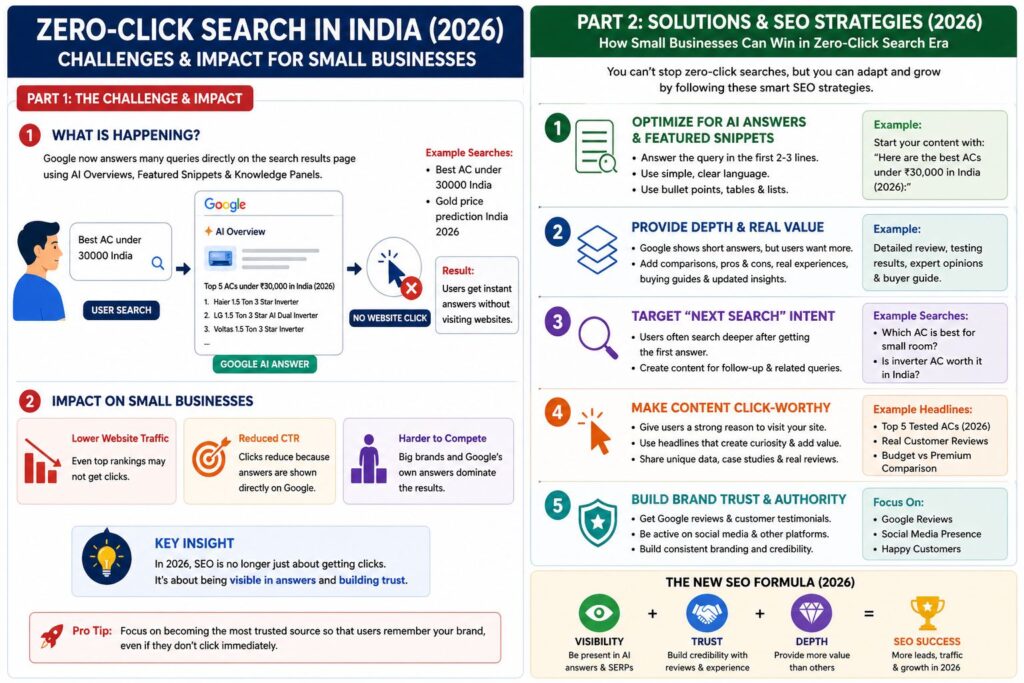
One of the biggest challenges in SEO today is the rise of zero-click searches. Google now directly answers many queries through featured snippets and AI Overviews, reducing the need for users to visit websites.
Common examples:
- “Best AC under 30000 India”
- “Gold price prediction India 2026”
In such cases, users often get all the information they need directly on the search results page without clicking any website.
Impact on small businesses:
- Drop in organic traffic
- Lower CTR even for top-ranking pages
- Harder to compete with Google’s own answers
How to Solve This
Instead of fighting zero-click searches, smart businesses adapt their SEO strategy:
Optimize for AI Answers & Featured Snippets
- Answer the query in the first 2–3 lines
- Use clear, direct sentences
- Add bullet points or lists
👉 Example:
“Here are the best ACs under ₹30,000 in India (2026):”
Focus on Depth (Your Real Advantage)
Google gives short answers but users want more.
👉 Include:
- Comparisons
- Pros & cons
- Real experiences
- Buying guides
Target “Next Search” Queries
Users search deeper after the first answer.
👉 Example:
- “Which AC is best for small room India?”
- “Is inverter AC worth it in India?”
Build Brand Recall
Users may not click immediately but they remember trusted brands.
👉 Focus on:
- Consistent content
- Social media presence
- Reviews & testimonials
Make Content Click-Worthy
Give users a reason to visit your site.
👉 Use:
- “Updated 2026 list”
- “Tested results”
- “Real customer experience”
2. Regional Language Search Growth
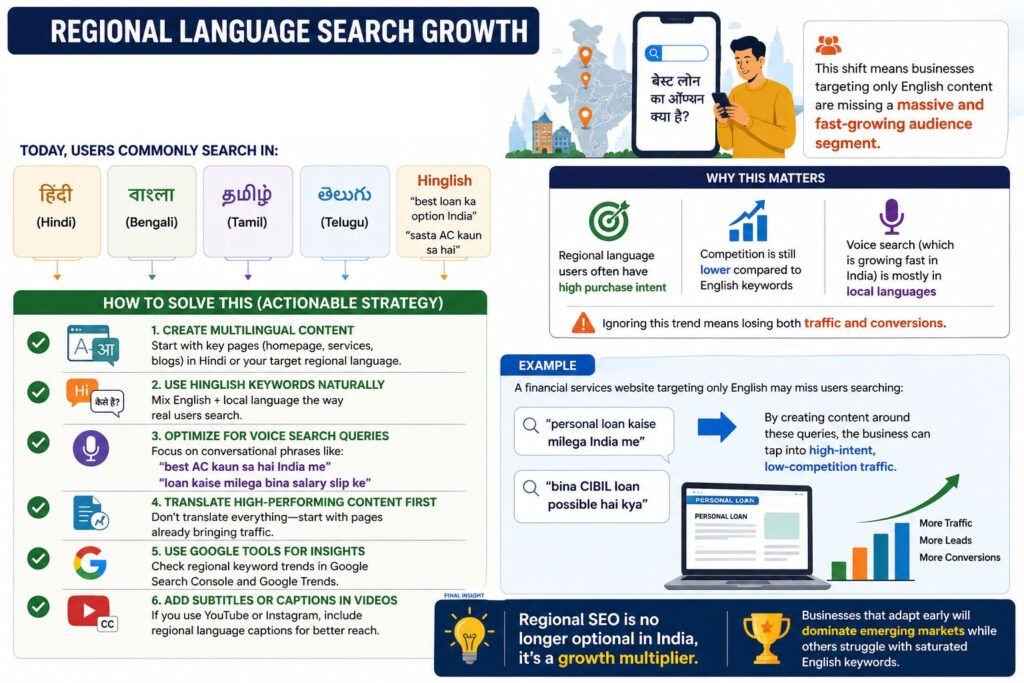
India’s internet growth is now largely driven by non-English users, especially from Tier 2 and Tier 3 cities. With affordable smartphones and cheaper data, millions of users prefer searching in their native languages or Hinglish rather than pure English.
Today, users commonly search in:
- Hindi
- Bengali
- Tamil
- Telugu
- Hinglish (e.g., “best loan ka option India”, “sasta AC kaun sa hai”)
This shift means businesses targeting only English content are missing a massive and fast-growing audience segment.
Why This Matters
- Regional language users often have high purchase intent
- Competition is still lower compared to English keywords
- Voice search (which is growing fast in India) is mostly in local languages
👉 Ignoring this trend means losing both traffic and conversions
How to Solve This
✔ Create multilingual content
Start with key pages (homepage, services, blogs) in Hindi or your target regional language
✔ Use Hinglish keywords naturally
Mix English + local language the way real users search
✔ Optimize for voice search queries
Focus on conversational phrases like:
- “best AC kaun sa hai India me”
- “loan kaise milega bina salary slip ke”
✔ Translate high-performing content first
Don’t translate everything, start with pages already bringing traffic
✔ Use Google tools for insights
Check regional keyword trends in Google Search Console and Google Trends
✔ Add subtitles or captions in videos
If you use YouTube or Instagram, include regional language captions for better reach
Example
A financial services website targeting only English may miss users searching:
- “personal loan kaise milega India me”
- “bina CIBIL loan possible hai kya”
By creating content around these queries, the business can tap into high-intent, low-competition traffic. Regional SEO is no longer optional in India, it’s a growth multiplier. Businesses that adapt early will dominate emerging markets while others struggle with saturated English keywords.
3. Trust (E-E-A-T) is Critical in India (2026)
In India, trust plays a decisive role in whether a user chooses your business or ignores it. Before making any decision, whether it’s buying a product, booking a service, or applying for a loan, users actively check reviews, ratings, and real customer experiences.
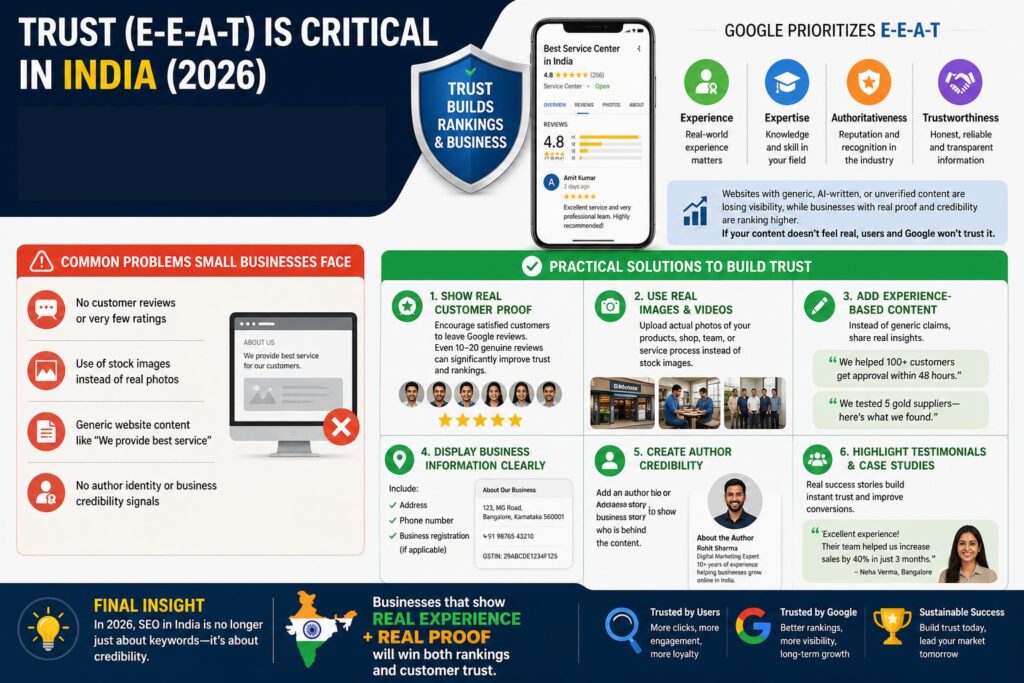
This behavior has become even stronger in 2026 because Google now prioritizes E-E-A-T (Experience, Expertise, Authoritativeness, Trustworthiness). As a result, websites with generic, AI-written, or unverified content are losing visibility, while businesses with real proof and credibility are ranking higher.
👉 Simply put: If your content doesn’t feel real, users and Google won’t trust it.
Common Problems Small Businesses Face:
- No customer reviews or very few ratings
- Use of stock images instead of real photos
- Generic website content like “We provide best service”
- No author identity or business credibility signals
Practical Solutions to Build Trust
✔ Show Real Customer Proof
Encourage satisfied customers to leave Google reviews. Even 10-20 genuine reviews can significantly improve trust and rankings.
✔ Use Real Images and Videos
Upload actual photos of your products, shop, team, or service process instead of stock images.
✔ Add Experience-Based Content
Instead of generic claims, share real insights:
“We helped 100+ customers get approval within 48 hours”
“We tested 5 gold suppliers, here’s what we found”
✔ Display Business Information Clearly. Include:
- Address
- Phone number
- Business registration (if applicable)
✔ Create Author Credibility
Add an author bio or business story to show who is behind the content.
✔ Highlight Testimonials and Case Studies
Real success stories build instant trust and improve conversions.
In 2026, SEO in India is no longer just about keywords, it’s about credibility. Businesses that show real experience + real proof will win both rankings and customer trust.
4. AI Search is Changing SEO (India 2026)
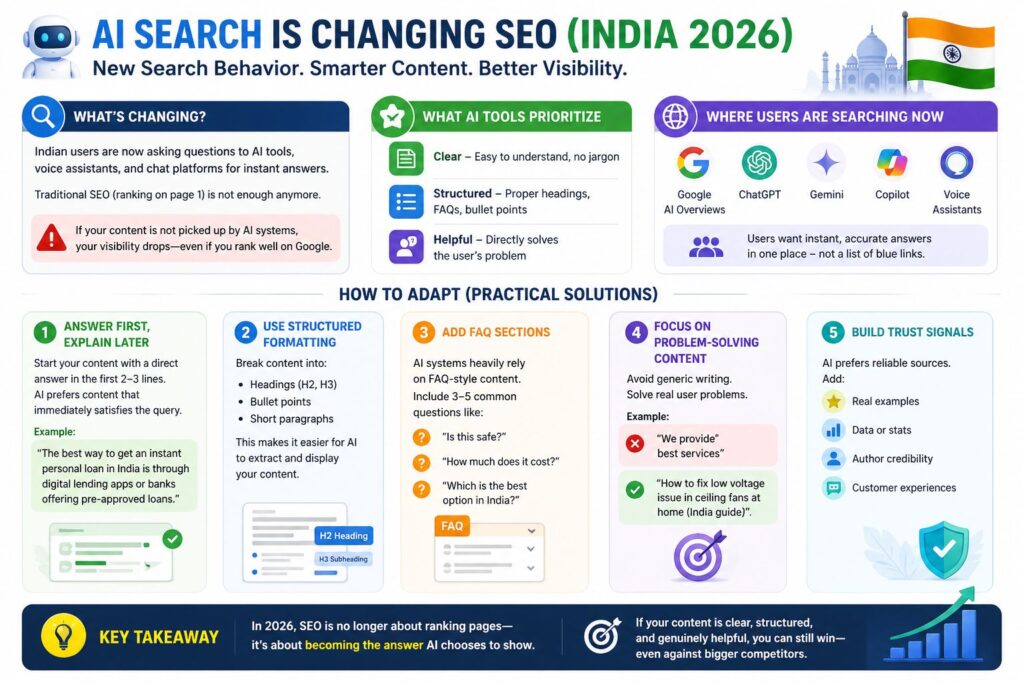
Search behavior in India is shifting fast. Users are no longer relying only on Google, they’re asking questions directly to AI tools, voice assistants, and chat-based platforms. Instead of browsing multiple websites, they expect instant, accurate answers in one place.
This means traditional SEO (ranking on page 1) is not enough anymore.
👉 If your content is not picked up by AI systems, your visibility drops, even if you rank well on Google.
AI tools prioritize content that is:
- Clear: Easy to understand, no jargon
- Structured: Proper headings, FAQs, bullet points
- Helpful: Directly solves the user’s problem
How to Adapt
1. Answer First, Explain Later
- Start your content with a direct answer in the first 2–3 lines.
- AI prefers content that immediately satisfies the query.
Example:
Instead of writing long introductions, begin with:
“The best way to get an instant personal loan in India is through digital lending apps or banks offering pre-approved loans.”
2. Use Structured Formatting. Break content into:
- Headings (H2, H3)
- Bullet points
- Short paragraphs
This makes it easier for AI to extract and display your content.
3. Add FAQ Sections
AI systems heavily rely on FAQ-style content. Include 3-5 common questions like:
- “Is this safe?”
- “How much does it cost?”
- “Which is the best option in India?”
4. Focus on Problem-Solving Content
Avoid generic writing. Solve real user problems.
Example:
❌ “We provide best services”
✔ “How to fix low voltage issue in ceiling fans at home (India guide)”
5. Build Trust Signals
AI prefers reliable sources.
Add:
- Real examples
- Data or stats
- Author credibility
- Customer experiences
Complete SEO Checklist for Small Businesses in India
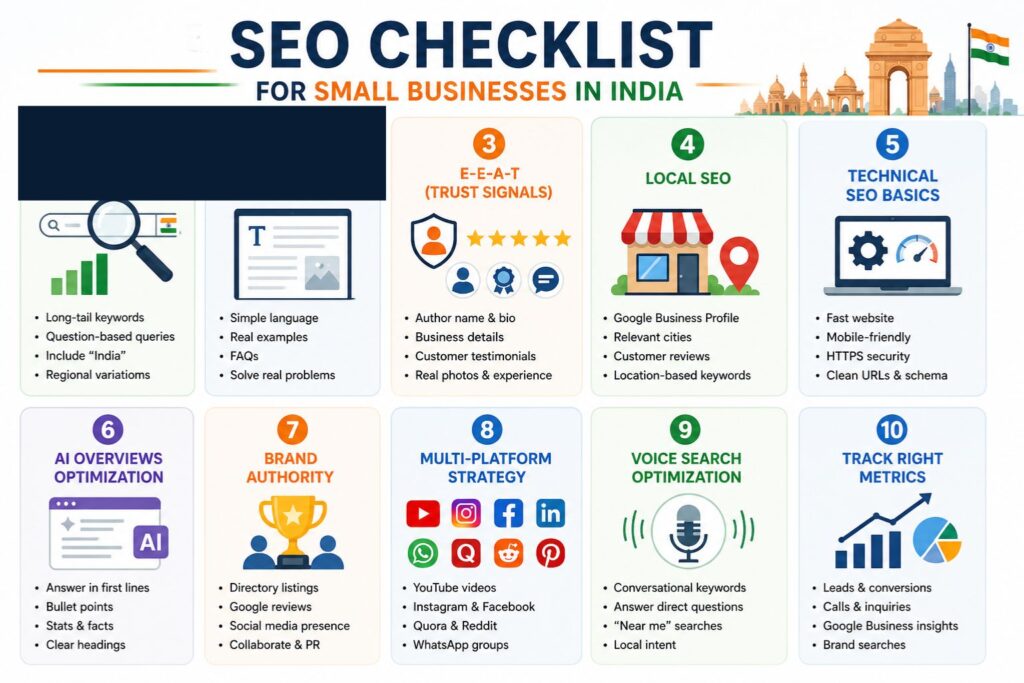
To succeed online in 2026, small businesses in India need more than just a website, they need a smart, well-structured SEO strategy. From targeting the right keywords to building trust and optimizing for AI-driven search, every step plays a crucial role.
This complete SEO checklist for small business covers the essential actions you need to improve visibility, attract the right audience, and grow your business online.
1. Keyword Research
Focus on how Indians actually search.
Do this:
- Use long-tail keywords
- Target question-based queries
- Include “India” where relevant
Examples:
- “Which bank gives instant personal loan in India?”
- “Best gold investment option India 2026”
2. Create Simple, Helpful Content
Indian audiences prefer clarity over complexity. Avoid generic statements, be specific.
Checklist:
- Use simple English
- Add real-life examples
- Include FAQs
- Solve real problems
3. Build E-E-A-T (Trust Signals)
This is one of the most important ranking factors. Trust = higher rankings + conversions
Add:
- Author name & bio
- Business address
- Customer testimonials
- Real photos
4. Optimize for Local SEO
Local SEO is a major growth driver in India.
Checklist:
- Create Google Business Profile
- Add business in relevant cities
- Collect customer reviews
- Use location-based keywords
Examples:
- “Best AC repair in Mumbai”
- “Affordable gold shop in Patna”
5. Technical SEO Basics
Even a simple website must be technically strong. By following a detailed technical SEO checklist, businesses can improve website performance, user experience, and search engine rankings.
Checklist:
- Fast loading website
- Mobile-friendly design
- HTTPS security
- Clean URLs
- Schema markup
6. Optimize for AI Overviews
Google AI prefers structured content.
Do this:
- Answer questions in first 2–3 lines
- Use bullet points
- Add stats & facts
- Use clear headings
7. Build Brand Authority
Brand signals are becoming more important than backlinks.
Checklist:
- Get listed on directories (Justdial, IndiaMART)
- Encourage Google reviews
- Be active on social media
- Collaborate with influencers
8. Multi-Platform SEO Strategy
SEO is no longer limited to Google.
Focus on:
- YouTube (video SEO)
- Instagram (local discovery)
- Quora & Reddit
- WhatsApp sharing
9. Voice Search Optimization
Voice search is growing rapidly in India.
Examples:
- “Best AC repair near me cheap”
- “Gold rate today India”
Checklist:
- Use conversational keywords
- Answer direct questions
- Optimize for “near me” searches
10. Track the Right Metrics
Don’t focus only on traffic. Don’t just rank. Be the most trusted answer.
Track:
- Leads & conversions
- Calls & inquiries
- Google Business insights
- Brand searches
FAQs
1. What is the most important SEO factor in India (2026)?
Trust (E-E-A-T), content quality, and local SEO are the most important factors.
2. Is SEO still useful for small businesses in India?
Yes, but it has evolved. Businesses must focus on AI, local SEO, and multi-platform visibility.
3. How can small businesses rank faster?
By targeting long-tail keywords, building trust, and optimizing for local searches.
Leave a Reply